The first global instrument to introduce the expression IUU fishing was the 2001 International Plan of Action to Prevent, Deter and Eliminate Illegal, Unreported and Unregulated Fishing (IPOA), a non-binding international tool.
Known as a toolbox for States to guide them in the fight against undesirable fishing practices, the IPOA is extensively referenced as the source of the definition of IUU fishing, contained in its paragraph 3. This definition has now been integrated in treaty law, the legal regimes of several States, and European Union legislation. Yet, despite its popularity, the term is controversial due to its lack of legal clarity.
In this blog post we explain that, rather than understanding the term as a single tool with which to assess conduct, it is useful to think of it as three distinct but overlapping categories. Each category presents a different perspective on undesirable fishing activities. Except for the first one, which is all-encompassing in its descriptive simplicity, the categories are not comprehensive. Further, they do not comprise a set of standards on which to judge the illegality of a fishing operation, or the conduct of a State in respect of its international obligations. In this respect, the 1995 Fish Stocks Agreement is better equipped to deal with such tasks.
First and second categories: illegal and unreported fishing
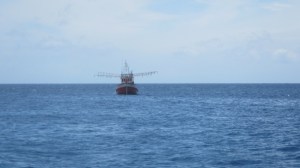
Cephalopod vessel in the waters of Thailand
The first category, that of illegal fishing, is set out in paragraph 3.1 of the IPOA. It is a straightforward description of what makes a fishery conduct a wrong in law at the domestic and international levels.
Firstly, domestically: when the conduct of a vessel (a more accurate reference would be to the person or persons responsible for its operation) contravenes applicable domestic law, it is illegal. Secondly, internationally: certain conducts by vessels may demonstrate a shortfall by the State responsible for their control in the observance of its international legal obligations. When this occurs, there may be an international wrong.
Ultimately, however, whether any illegality has indeed occurred will need to be determined by a relevant authority. Domestically, this may be an administrative authority or a court of law. Internationally, a tribunal with jurisdiction.
A second category, that of unreported fishing, is set out in paragraph 3.2 of the IPOA. Domestically, it refers to vessel conducts that contravene the specific laws that regulate the reporting of fishing activity or catch. Internationally, paragraph 3.2 goes on to refer to activities that contravene the rules of regional fishery management organisations (RFMOs) in areas of the high seas where they have regulatory competence. The reference to a contravention implies that the subject (a State) must have agreed to abide by those rules [Ref 1]. If such State permits a vessel in its register to operate in a manner that is inconsistent with those rules, the State may be committing an international wrong. Hence, domestically as well as internationally, unreported fishing is a sub-category of illegal fishing. Curiously, other than RFMO rules no reference is made in the IPOA to the contravention of international laws that oblige States to report on fishery data. Given this incompleteness, unreported fishing has little value as a legal category beyond national and regional management contexts.
These categories describe what illegality looks like, but they do not act as legal yardsticks. Domestically, the illegality of a fishing activity can only be determined by way of assessment of the conduct of an operator against the applicable municipal laws by a competent authority. These laws may vary from country to country. However, before the birth of the IPOA, the 1995 Fish Stocks Agreement (FSA) had already typified a number of fisheries activities that it referred to as serious violations. State parties to the FSA are required to address those violations in their respective domestic legal regimes. The non-exhaustive list in FSA Article 21.11 includes conducts such as fishing without authorisation, failing to report catch, using destructive fishing gear, or obstructing an investigation by concealing evidence, to name a few. Hence, in FSA State parties at least, those will be the conducts that will be restricted or outlawed – they will be the illegal fishing conducts to which the IPOA refers or, at least, some of them.

Reef fish in the Celebes Sea, a frequent target of dynamite fishing
However, the regulatory influence of the FSA does not extend to non-parties, or to the conservation and management of stock that is neither straddling nor highly migratory. Where non-transboundary stock is located in the EEZ of a coastal State, it is left to the discretion of that State to determine what fishing activities should be restricted or outlawed. It will need to do this within the general parameters of international law, the 1982 UN Convention on the Law of the Sea (UNCLOS) and other treaties to which it is bound, including bilateral agreements.
Whether illegal fishing conducts may also be typified as criminal will depend on the discretion of each State. The FSA does not oblige State parties to criminalise any fishery behaviours, only to address certain conducts as serious violations. Most countries choose to do this by way of non-criminal public law and administrative measures. Currently, illegal fishing is not considered a transnational crime in accordance with the UN Convention on Transnational Organized Crime, and therefore States are not obliged to treat it as such. Further, the IPOA discourages this, considering the rigours of criminal law in terms of proof and process too onerous. It is, however, noteworthy that some States have chosen to criminalise some specific conducts associated to illegal fishing practices (click here for information in respect of criminalisation in Korea). In other cases, strategy documents have referred to illegal fishing as a crime, but the relevant legislators have failed to adopt the necessary laws to ensure criminalisation in their domestic regimes (click here for information on the integrated maritime security strategy of the African Union).
Finally, a domestic instance of illegal fishing – whether criminal or not – will be of little significance internationally unless an international legal standard of conduct has also been contravened by a State with responsibility. At the time of writing, such legal standards are principally found in general international law, UNCLOS, the 1995 Compliance Agreement and, in respect of straddling and highly migratory stock, the FSA. Whilst several paragraphs of the IPOA have substantially defined some of those rules, its voluntary nature makes it unsuitable as a yardstick against which the conduct of a State can be assessed in order to determine its possible illegality.
Third category: unregulated fishing
The third category, unregulated fishing, is set out in paragraph 3.3 of the IPOA. It has two distinct prongs:
The first one refers to activities carried out inside areas and for stocks under the regulatory competence of RFMOs, in a manner that is inconsistent with their conservation rules. Such activities must be carried out by vessels without nationality, or by vessels flying the flag of a State that has not agreed to be bound by the rules that RFMO (for States who have agreed to this, the activity contravening the rules would be categorised as illegal fishing, as explained above). In effect, this label is slightly misleading, because the sea areas and stocks to which it refers are regulated by RFMOs, notwithstanding the States or vessels’ choice to disregard such regulation.
The second prong refers to activities carried out in a manner inconsistent with the flag State’s international obligations in respect of high seas areas or stocks not affected by RFMO conservation or management rules. Hence, the label unregulated fishing here refers to the absence of RFMO rules.
Although superficial reading of paragraph 3 of the IPOA may suggest that unregulated fishing is an entirely separate category from illegal fishing and is therefore legal, this is not the case. As paragraph 3.4 of the IPOA subsequently clarifies, unregulated fishing will also be illegal if it is inconsistent with the flag State’s international obligations. Beyond obligations acquired in the institutional context of RFMOs, States also have conservation and cooperation obligations derived from general international law and applicable treaty law. However, the protection offered to those ocean areas and stocks by international law is generally considered thin and unclear in practical terms, making assessments of legality particularly difficult. This is specially so in cases where States have not agreed to important treaties such as the 1982 UN Convention on the Law of the Sea or the 1993 Compliance Agreement, or where no other binding rules (such as those that may be established in a bilateral agreement) exist.
Hence, unregulated fishing is a wide spectrum category comprising high seas activities that are always pernicious insofar as they undermine conservation and cooperation efforts, but whose illegality may be uncertain in accordance with the current international framework. The value of this category lies not in its ability to facilitate an assessment of what may constitute legal or illegal conduct, but in its usefulness to ascribe a negative value to certain fishing activities irrespective of their illegality. This can be practical for a State or group of States who have adopted certain conservation rules, and have to deal with other States who have not done so. The conserving States may be reluctant to commence international proceedings against the non-conserving States for many reasons, ranging from the political undesirability of engagement in a high profile dispute, to cost, to lack of confidence in the international legal framework, to name a few. In this context, such States may opt for the deployment of trade measures against non-conserving States. Amongst the advantages of this process are the presence of incentives, as well as the avoidance of the rigours associated to international legal process. Subject to a number of procedural conditions, if the products from the non-conserving States have been captured in a manner that is detrimental to conservation and are excluded by the conserving States on the basis of a non-discriminatory process, they may be considered compliant with the rules of the World Trade Organisation and be, therefore, viewed as legitimate. See the commentary on the Shrimp Turtle decision of the WTO Appellate Body in respect of Paragraph (g) in Article XX of the 1994 GATT for more information.
Conclusion
The ‘hold all’ composite term IUU Fishing is instrumental in ascribing a negative value to a wide range of fishing and fishery support activities whose illegality is uncertain in order to enhance the accountability of operators and States through trade measures. Beyond this, paragraph 3 of the IPOA does not constitute a proper standard against which the conduct of an operator or a State can be legally assessed by a relevant administrative or judicial authority. Its voluntary nature makes it unsuitable for this task in any event. Appropriately therefore, the IPOA does not list actual behaviours by private actors that States can then domestically class as illegal. By contrast, the FSA does contain such list in respect of fishery activities targeting straddling and highly migratory species. The list in its Article 21.11 should be replicated, expanded and changed where necessary to be made applicable to non-transboundary stocks across domestic regimes, and in the context of bilateral fishery agreements [Ref 2]. This, plus the treaty’s integral management of RFMO conservation consent by State parties makes its adoption and implementation essential in the management of illegal fishing and the delimitation of unregulated fishing to cases where there is no RFMO regulation. The FSA is, therefore, an essential tool in the regulation of fisheries and the eradication of illegal practices, and States should work hard to foster its generalised adoption alongside the adoption of national plans of action and the Port State Measures Agreement.
[Ref 1] Theilen, Jens T. “What’s in a Name? The Illegality of Illegal, Unreported and Unregulated Fishing.” International Journal of Marine and Coastal Law 28, no. 3 (2013): 533–50.
[Ref 2] The list in FSA Art. 21.11 has been replicated and expanded upon by Council Regulation (EC) 1005/2008 (the EU IUU Regulation).





 HOUSE of OCEAN
You must be logged in to post a comment.