In 2023, the Mercatus Center (George Mason University, in Virginia) and the Center for Governance and Markets (University of Pittsburgh, Pennsylvania) hosted a joint roundtable event dedicated to addressing persistent problems in global overfishing. The inspiration behind the event had been the launch of the Fisheries Subsidies Agreement of the World Trade Organization (WTO), which provided the unifying thread for a series of discussions by several experts across different fields. The roundtable took place in Pittsburgh in the Summer, and preceded a number of written contributions that were subsequently published as part of a compendium of Policy Briefs hosted by the Mercatus Centre, all of which are accessible here.
The purpose of the compendium is to explore solutions for enduring global problems involving overfishing and illegal fishing, and to inform the debate on fisheries subsidies, as well as related issues, as they are periodically debated under the auspices of the WTO and other economic and policy fora. Christine McDaniel and Ilia Murtazashvili, respectively of the Mercatus Centre and the University of Pittsburgh, have recently published a very useful paper with a summary of the topics that have been covered by all Policy Briefs in the compendium, which can be accessed here. As can be seen from the references to the topics covered by the different authors, concerns are varied and include implementation issues (particularly in the context of indigenous and small-scale fisheries) as well as agreement weaknesses and loopholes, and insight into the governance of fisheries resources as a shared concern of the global community.
A summary of all the contributions as well as links to each individual paper is kindly provided by the authors for ease of reference. My own contribution to the compendium, named ‘Can the WTO Help Fight IUU Fishing through Clarity-Enhancing Market Measures?’ can be accessed here. I hope you find this and other contributions interesting and useful.
In 2022 the European Union (EU) and New Zealand (NZ) concluded a free trade agreement, signed on 9 July 2023, which has been heralded as a landmark setting instrument for the protection of environmental concerns. The purpose of this blog post is to offer insight into the features of the agreement in matters of marine fisheries and into whether and how it will preserve the EU Single Market form the erosion of existing commercial fishing regulation and control standards.
Image credit: Euractiv.com
The Commission had announced prior to signature that the trade deal with New Zealand would not change European standards, and that the agreement would support international environmental commitments already made, while preserving each party’s right to conduct the regulation production and trade processes within their respective jurisdictions. Both the EU and NZ highlighted that the effective implementation of applicable international environmental agreements would be considered a matter of priority. The Commission indicated that attention would be paid to areas where trade and environmental agendas can support each other, including marine fisheries, and that care would be taken to promote trade in legally harvested and sustainable products.[1] Such manifestations imply the importance that the parties have attached to compliance with and implementation of international fisheries-relevant agreements, such as the Convention on International Trade in Endangered Species (CITES), the Agreement for the Implementation of the Provisions of the United Nations Convention on the Law of the Sea of 10 December 1982 relating to the Conservation and Management of Straddling Fish Stocks and Highly Migratory Fish Stocks (Fish Stocks Agreement or UNFSA), and other relevant treaties.
In the next few paragraphs, I review the fisheries-specific provisions of the EU-NZ trade agreement with a view to unwrapping the ways in which the agreement strengthens fishery governance and, if so, what tools and mechanisms it puts in place.
That the agreement contains explicit references to fisheries conservation and management and IUU fishing control should not come as a surprise: Firstly, the EU has the ambition to consolidate its presence in the Indo-Pacific, where it sees New Zealand as an important partner.[2] EU strategy in the region has prioritised prosperity alongside ocean governance and security, including maritime security, amongst other areas.[3] By implication, these priorities involve consolidating the presence and influence of EU in cooperation fora in the region, including fisheries governance institutions, and cooperating with trade partners to cement common approaches.[4] Secondly, sustainable trade and stopping the decline of biodiversity loss are also stated priorities of the EU in the region,[5] and it is clear that the Commission sees trade partnership agreements as an important part in the attainment of such strategy objectives.[6]
The agreement considers fishery products to be ‘wholly obtained’ in one party within the meaning of Art. 3.4(1) if they have been captured inside the territorial sea of that party (subparagraph f), or captured as part of marine fishing operations outside of the territorial sea in accordance with international law by a vessel flagged to a party (subparagraph h), or produced on board of a factory ship flagged to a party provided that the product results from the captures just specified (subparagraph i). Further, as is logical, habitual fishery management mechanisms such as the restriction of captures via the use of quotas, licences, or other tools, are excluded from the prohibition to restrict market access due to the establishment of quantitative limitations on enterprises, transactions, assets, or operations, established in Article 10.5(a) of the agreement.
An important provision is contained in Article 16.4, prohibiting harmful fisheries subsidies, and establishing cooperation mechanisms of a legal and non-legal nature, which include the implementation of the WTO Agreement on Fisheries Subsidies of June 2022. The effect of this is, inter alia, the prohibition of subsidies that contribute to enabling IUU fishing operations, as well as subsidies that sustain overcapacity and overfishing. This complemented by a broad accountability-contributing mechanism contained in Article 16.5, whereby the parties agree to disclose the form, quantum, recipients, and legal bases of subsidies within one year of the entry into force of the agreement and biannually thereafter.
The broadest section of the agreement with regard to fisheries governance is comprised in the series of provisions contained in Article 19.10, concerning trade and sustainable management of fisheries and aquaculture. The article commences with the acknowledgement of the role of trade in the management of fisheries and the broader context of marine resources and ecosystems, and the dependency of the sustainability of trade in fishery products from fishery management, removal of harmful subsidies, and IUU fishing control, highlighting the need for action to attain those ends (respectively subparagraphs 1 and 2). This provides context for a series of further declarations and commitments in subsequent subparagraphs.
Article 19.10(3) in subparagraph (a) sets out conservation and management obligations for the parties to “implement long-term conservation and management measures to ensure sustainable use of marine living resources based on the best scientific evidence available, the application of the precautionary approach and internationally recognised best practices” consistent with the LOSC and with applicable international fisheries law. The purpose of this obligation is stated to be to prevent overfishing and overcapacity, minimise by-catch of on-target species and juveniles, and promote the recovery of overfished stocks (respectively subparagraphs (i), (ii), and (iii)). Subparagraph (b) then establishes obligations in regard to international cooperation, and directs the parties to “participate constructively in the work of the regional fisheries management organisations” of which they are members, observers, or cooperating non-members, with the aim of achieving sustainability and good governance. Lastly, subparagraph (c) requires the parties to “implement an ecosystem-based approach to fisheries management” to minimise the broader impacts of fishing activities, particularly with regard to species recognised as threatened.
Paragraphs (4) and (5) of Article 19.10 address IUU fishing, commencing with an acknowledgement of international cooperation and coordination framed by international instruments, and following with an obligation to support monitoring, control, surveillance, and compliance and enforcement systems and measures serving to deter nationals and registered vessels from engaging or supporting IUU fishing and to responds when this occurs, and to encourage traceability tools, cooperation, and information exchange. Finally, paragraph (7) brings the article to an end by establishing a cooperation duty in trade related matters, whether bilaterally, regionally, or globally, and in all relevant fora, with a view to promoting sustainable fishing and trade practices.
These fisheries-specific provisions are then couched in general rules that are important for the seafood production and trading systems of both parties. For example, in Art. 19.12 the agreement refers to rules of responsible business and trade conduct and related corporate responsibility practices in the context of various relevant international voluntary frameworks that greatly reinforce environmental and social responsibility in the architecture and functioning of custody chains. Further, cooperation commitments are reiterated in various contexts, such as the conduct of trade in paragraph 12, the exchange of scientific and technical information in paragraph 13.
To summarise, the fisheries provisions of the agreement are wholly consistent with the strategic priorities of the EU in the Indo-Pacific region. As such, the agreement reiterates existing commitments made by the EU under international fisheries agreements such as the UNFSA, the 1993 FAO Compliance Agreement, and the 2009 Port State Measures agreement to strengthen the regulation of and oversight over fishing activities, and to exercise cooperation to enhance those ends and attain improved conservation and management of marine fisheries.
Most of the indicated agreement measures do not therefore innovate over existing legislation, or the regulatory status quo in the EU. Firstly, the agreement contextualises the fisheries activities of the parties in its logical UNCLOS framework. While it is rare (though not unknown) for declarations that specific fishery products have been obtained or produced in breach of international law, this first point of contact of the agreement with the need for fishery products to be obtained or produced in a manner that is consistent with international obligations is a welcome statement that reinforces the visibility and importance of international law. The agreement in Article 3.23 enables customs authorities to carry out verification checks to assess the origin the products in question, but stringent regulations dealing with the legality of seafood products from third countries into the internal market of the EU are already in existence,[7] and the agreement does not really innovate in that respect.
Another reiteration of the state of regulatory affairs is framed in Article 19.10, which restates important duties involving cooperation and conservation and management of marine fisheries resources under existing and well-established international treaty frameworks. Yet, these are nevertheless reinforced by the provisions in Art. 19.12 in which the parties agree to promote responsible corporate practices, which are without doubt an important part of the key undercarriage to the successful implementation of said duties. Also worth highlighting is the provision in Article 16.4, which constitutes the visible implementation of recently made commitments under the WTO Agreement of Fisheries Subsidies by the EU in respect of IUU fishing, a welcome and visible sign of EU policy in this respect, vigorously underscored with transparency commitments that reinforce accountability for both parties.
Hence, overall the agreement consolidates existing commitments but also establishes the direction of travel in respect of some new policies. It further reinforces the role of trade as the strategic pièce de résistance for the EU in matters of fisheries control and conservation and management, now also made explicit in the context of its Indo-Pacific strategies.
The author would like to thank Dr. Dirk Siebels and Dr. Ife Sinachi Okafor-Yarwood for the provision of valuable information for the elaboration of this blog, as well as Dr. Dyhia Belhabib for facilitating free data via the Spyglass online platform, and Juan Vilata for access to photographic material. Any errors contained in this blog post are the author’s alone.
West Africa harbours ocean waters rich in pelagic and demersal species,[1] yet also intensely harvested. Many commercially significant stocks are either fully or overexploited, and vulnerable to illegal, unreported and unregulated (IUU) fishing.[2] A significant proportion of industrial fishing activity is carried out by distant water fishing fleets, including those of the European Union, Russia, and China. Vessels belonging to these and other fleets have been associated with IUU fishing activities in the region, and documented cases may well be unrepresentative of the total number. Indeed, IUU fishing activities are often difficult to ascertain due to their secretive nature, and a lack of effective monitoring and surveillance capabilities in the region’s coastal States.[3] There is also a significant incidence of de-stabilising activities, particularly in certain areas of the Gulf of Guinea, including serious crimes such as piracy, armed robbery, and drug trafficking.[4] Fishing vessels can contribute to this de-stabilisation: IUU fishing has been shown to pose a threat, undermining the security of coastal States and their people, and exacerbating other security stressors.[5]
Transhipment and its association with IUU fishing and maritime crime
The complex relationship between the fishing industry and transnational maritime crime was highlighted in 2011 by UNODC, shedding light into the operational synergies that interconnect fishing operations, specially IUU fishing activities, and drugs trafficking and other forms of criminality.[6] The contribution that fishing vessels make towards drug trafficking globally has recently been estimated, suggesting that shipments on board of industrial fishing vessels average at 2.4 tonnes per seizure, with artisanal vessels averaging at circa 0.8 tonnes per seizure, but commanding higher prices. The stakes are high, and West Africa has been identified as one of the hotspots.[7]
Transhipment (nighttime). Image credit: Juan Vilata
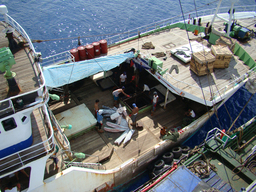
Transhipment at sea gives vessels operational options, including the opportunity to relocate items away from the scrutiny of port authorities. Hence, transhipment is often an integral part of maritime crime.[8] Simply put, transhipment involves offloading cargo from one vessel to another. This can be fish, but also provisions or any other cargo, including crew. It is far from uncommon, especially in remote high seas, where it is particularly difficult to oversee. Significant investment in monitoring, control and surveillance (MCS) is often necessary to ensure that unauthorised transhipment and other IUU fishing operations are identified.[9]
The complexity of MCS needs should not be underestimated. The capacity levels that are often required are exemplified by the recent collaborative programme between EFCA and the States of the Sub-Regional Fisheries Commission (SRFC), through which a surveillance operation was undertaken. This involved not only VMS monitoring, but also the satellite and radar equipment of the European Copernicus service, as well as coordinate information exchange efforts of the national authorities of the SRFC member States.[10] Unfortunately, these special cooperation programmes are usually time-limited, and in routine scenarios national capabilities can and often do fall short of the technical capacity needed to address all IUU fishing activity successfully. Around the globe, countries concerned about their maritime security and the activation of their blue economies have invested in advanced satellite fisheries intelligence programmes.[11] Although States in West Africa are working towards increasing their capacity to fully implement effective MCS systems, they have not yet achieved the kind of MCS capacity that would enable them to control IUU fishing activities comprehensively and effectively.[12]
A game of smoke and mirrors
Although transhipment usually occurs between a fishing vessel and a refrigerated cargo vessel (often referred to as reefers), controls may be further complicated by the fact that other ships can also perform transhipment operations and other activities such as bunkering.[13] Of course, the non-compulsory nature of AIS, specially in waters where the presence of piracy and other violent crimes often justifies decisions to turn it off, means that effective monitoring via AIS alone can be very difficult. Nevertheless, erratic AIS readings can be indicative of activity that could form part of IUU operation patterns. For example, a vessel could disconnect AIS whilst moving toward safer waters where fishing vessels are known to be operating. It should be highlighted that such irregularities do not constitute evidence of wrongdoing per se, but they could be an indication of possible risk that an unauthorised transhipment is taking place. This is specially so in regions where IUU fishing transgressions involving transhipment are routinely documented.[14]
By way of example, recent research in the Indian Ocean has suggested that cases of unauthorised transhipment may be linked to bunkering activity. Though difficult to detect with conventional VMS and satellite automatic identification systems (AIS) controls, the researchers observed the presence of bunker vessels in the vicinity of fishing vessels and large factory trawlers, whose AIS signals suggested erratic behaviour, indicating the possibility of multiple re-supplying operations rather than fuelling.[15] Available AIS readings suggest that these scenarios are likely to be replicated in other regions, particularly in areas that continue to suffer from a high incidence of IUU fishing events, and where vessels able to perform bunkering as well as transhipment are present, such as West Africa.
Transhipment (daytime). Image credit: Juan Vilata
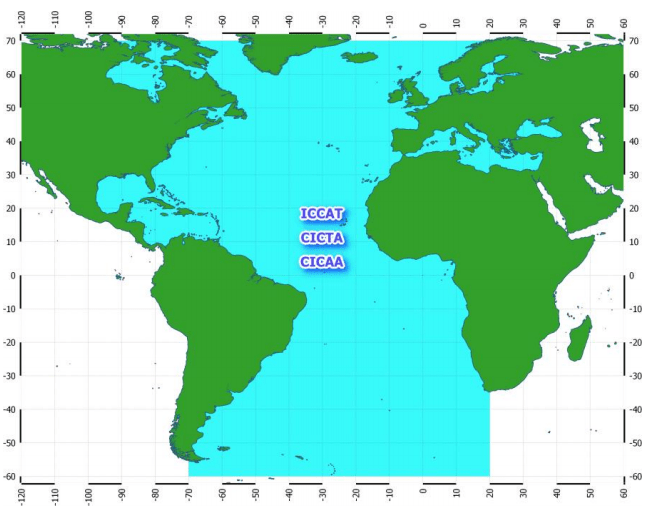
Recent research undertaken with satellite based AIS and satellite assisted radar in parts of the South East Atlantic managed by the Commission for the Conservation of Atlantic Tunas (ICCAT), comprising both the EEZ of Ascension Island and surrounding high seas areas, unveiled behaviour indicative of possible unauthorised fishing and transhipment and/or bunkering or supply, particularly around the EEZ borders, and especially by long liners.[16] Further, ICCAT records also indicate that transhipments are engaged into without adequate supervision, and that they may well be avoid inspection because fish and other cargo transfers are often impossible to differentiate from bunkering and supply operations.[17]
Further, as already stated, unauthorised transhipment is often an enabler to transnational maritime crime. Enquiry into the free online facility www.spyglass.fish reveals that drug trafficking offences have been documented in the West African region, both across the high seas and the EEZs of a number of States, all occurring alongside a very high volume of unauthorised fishing activity across the region. These overlaps, coupled with unusual or unexplained AIS readings, suggest an operational risk profile that warrants significant control and monitoring effort, as well as the adoption of surveillance mechanisms to safeguard compliance.
The ICCAT management area. Image credit: ICCAT
Responsibilities of States with regard to transhipment
Under UNCLOS Part V, coastal States must ensure that fishing activities in their EEZ are appropriately managed (especially important are Articles 61 to 64 in this regard). As ITLOS highlighted in paragraph 113 of its Advisory Opinion, member States of the Sub-Regional Fisheries Commission must ensure that transhipments occur in specially designated harbours, amongst other requirements.
The responsibilities of flag States in the EEZ of coastal States were also discussed in detail by the ITLOS in its Advisory Opinion. In paragraph 114, ITLOS indicated that flag States must ensure compliance with the laws and regulations of the coastal States in which their vessels operate – this is of course not an optional matter or a courtesy: when it comes to fishing activities in the EEZs of coastal States, flag States have specific obligations under Articles 58.3 [“States shall have due regard to the rights and duties of the coastal State and shall comply with the laws and regulations adopted by the coastal State in accordance with the provisions of this Convention and other rules of international law (…)”] and 62.4 [“Nationals of other States fishing in the exclusive economic zone shall comply with the conservation measures and with the other terms and conditions established in the laws and regulations of the coastal State (…)”].[18]
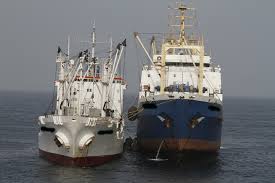
Transhipment in West Africa. Image Credit: Richard White, Lindblad Expeditions
In addition, flag States have general obligations – see in particular UNCLOS Articles 94 concerning the exercise of effective jurisdiction and control over fishing vessels in the high seas, and Article 192 regarding the obligation to protect and preserve the marine environment in all ocean areas.[19] These responsibilities are refined and complemented by obligations established in other important international instruments.[20] Further, regional agreements frequently impose additional and often very specific duties. In the West African fishing grounds of the Atlantic the measures adopted by ICCAT should be complied with, so that the fishing and transhipment activities occurring in the area can be appropriately monitored.[21] Under ICCAT rules, only vessels that have been authorised to engage in transhipment can receive fishing products from fishing vessels lawfully operating in the regulated area.
Yet, ICCAT rules on the monitoring of transhipment is widely regarded as insufficient. In particular, whereas purse seiners carry 100% observer coverage when operating in the ICCAT area, long-liners are subjected to little scrutiny by comparison.[22] The ICCAT member States had an opportunity but failed to enhance their approach to monitoring in their latest (2019) meeting of the parties.[23] This has occurred against a backdrop in which historical VMS data is contributed to ICCAT by the relevant vessels’ flag States, but has been acknowledged as difficult to navigate and process in order to clarify compliance.[24]
Such voids in ensuring appropriate monitoring of transhipment, a high-risk operation for the purposes of IUU fishing and maritime crime, leaves significant opportunities for wrongdoing, particularly in an area where satellite MCS approaches are still in development and the EEZs of coastal states are vulnerable to unauthorised intrusion. This void in monitoring requirements also perpetuates a discrepancy in fishery conduct standards across different vessel types that is difficult to justify in an international decision-making forum with important management competences. Indeed, RFMOs such as ICCAT are key fora where States bring into effect their international obligation to cooperate in matters of conservation and management of transnational fish stocks. International cooperation is a responsibility that is not satisfied simply by ticking a box for attendance to meetings, but also requires a conduct that makes negotiation and ensuing decision-making meaningful.[25] Indeed, this is what to a great extent furnishes the regulatory output of RFMOs with an authoritative force, especially when it comes to considerations involving the characterisation of activities as IUU fishing, including the activities of non-members. Needless to say, this authoritative strength should not be undermined by maintaining necessary controls weak – least of all by the members themselves.
Mercedes Rosello July 2020
[1] J Alder, and UR Sumaila, ‘Western Africa; A Fish Basket of Europe Past and Present’ (2004) 13(2) The Journal of Environment & Development 156-178, 160.
[2] D Belhabib, UR Sumaila, and P Le Billon, ‘The fisheries of Africa: Exploitation, policy, and maritime security trends’ (2019) 101 Marine Policy 80-92, 81.
[3] I Okafor-Yarwood, and D Belhabib, ‘The duplicity of the European Union Common Fisheries Policy in third countries: Evidence from the Gulf of Guinea’ (2020) 184 Ocean and Coastal Management 1-11, 2.
[4] D Belhabib et al, page 86. See also D Siebels, ‘Pirates, smugglers and corrupt officials – maritime security in East and West Africa’ (2020) 1(1) International Journal of Maritime Crime & Security 34-49.
[5] I Okafor-Yarwood, ‘The cyclical nature of maritime security threats: illegal, unreported, and unregulated fishing as a threat to human and national security in the Gulf of Guinea’ (2020) 13(2) African Security 116-146, 122.
[6] E De Coning, ‘Transnational Organized Crime in the Fishing Industry’ (UNODC, 2011).
[7] D Belhabib, P Le Billon, and DJ Wrathall, ‘Narco-Fish: Global fisheries and drug trafficking’ (2020) Fish and Fisheries, 1-16, 6.
[8] See I Chapsos, and S Hamilton, ‘Illegal fishing and fisheries crime as a transnational organized crime in Indonesia’ (2018) 22 Trends in Organized Crime 255-273.
[9] For more information on transhipment activities, see NA Miller et al, ‘Global Patterns of Transshipment Behavior’ (2018) Frontiers in Marine Science 240.
[15] JH Ford, B Bergseth, and C Wilcox, ‘Chasing the fish oil – Do bunker vessels hold the key to fisheries crime networks?’ (2018) Frontiers in Marine Sciencehttps://doi.org/10.3389/fmars.2018.00267.
[16] G Rowlands et al, ‘Satellite surveillance of fishing vessel activity in the Ascension Island
[18] ITLOS in Paragraph 111 of its Advisory Opinion refers broadly to ‘nationals’ rather than just vessels registered to the flag State [‘Advisory Opinion’].
[19] See Advisory Opinion from paragraphs 117 to 124, and 136.
[20] In particular, the UN Fish Stocks Agreement is a treaty of profound significance for the management of highly migratory and straddling species that occur partially in the EEZ.
[24] See M Ortiz, A Justel-Rubio, and A Parrilla, ‘Preliminary Analyses of the ICCAT VMS Data 2010-2011 to Identify Fishing Trip Behavior and Estimate Fishing Effort’ (2013) 69(1) Collect. Vol. Sci. Pap. ICCAT 462-481.
[25] M Hayashi, ‘The Management of Transboundary Fish Stocks under the LOS Convention’ (1993) 8(2) International Journal of Marine and Coastal Law 245-262, 252.
I trust readers will excuse the personal nature of this blog post, but I felt it was important to mark the end of my PhD journey with a short piece. All rites of passage merit acknowledgement, and this one is no exception.
Hull Marina. Image credit: imagesofhull.co.uk
Firstly, committing several years of your life to this type of endeavour means you must sometimes rely on the good will and patience of others, specially during the difficult times that can (and do) crop up when you least need or expect them. I have been extraordinarily fortunate, and my partner and family have proudly supported me to an extent that has exceeded all reasonable expectation. The gratitude I feel for them cannot be expressed in words. I have also been lucky to have had great mentors, who have guided me through what started as a daunting maze, which eventually turned into a pathway of intellectual discovery. I specially owe gratitude to my principal supervisor at the University of Hull, Professor Richard Barnes. I am also grateful to my successive second supervisors Drs. Vassilis Tzevelekos and Carmino Massarella, and to the wonderful friends and colleagues from the Law and Politics school and beyond, that I have had the privilege of sharing the PhD journey with in different ways: Nkiruka, Eva, Timea, Yuchen, Rick, Loria-Mae, Ife, Nezihe, Zoe, Flavia, Talal, David, Nuhu, Lillie, Mustafa… to name but a few! All of you have made this moment possible.
Secondly, I should add that I was immensely lucky to be awarded a scholarship by the University of Hull, and I will always be grateful to this brilliant institution for the opportunity this has afforded me. Without the university’s financial assistance, I doubt I would have been able to invest the necessary study time to conduct my research successfully. Yet, in this journey I have met some incredible people who have financed their PhD through their own work, and who even look after their families at the same time. My admiration has no limits, and to all of you who currently are, or have been, in that situation I say: I take my hat off to you, for you are superheroes!
Lastly, I would like to thank the many, many people who have encouraged and inspired me along the way. I owe special gratitude to the Environmental Justice Foundation, my employer at the time when I returned to legal study, whose phenomenal work on IUU fishing re-ignited my passion for the law (if curious, you can visit their website here).
A small handful of you have told me over the past couple of years that you have been mulling over the idea of embarking on a similar journey yourselves. The PhD is like a marathon in which you compete against your own limits of commitment and resilience. It is a life-changing experience from which you are unlikely to emerge entirely unscathed. But if, like me, you love your field of work, believe in the importance of good research, and know in your heart that your priority is to make a difference through knowledge, then you too should enter the race. I look forward to greeting you on the other side.
We have great pleasure in introducing our new legal consultant and researcher, Eva van der Marel. Eva has joined us this month, bringing a wealth of legal knowledge and skills to House of Ocean, including extensive research on IUU fishing control measures.
Eva van der Marel with Mercedes Rosello
Eva is a dedicated researcher, and her academic accolades include a first class Masters in Environmental Law and Policy, which she obtained at University College London, and a Masters in European Law from the University of Rennes 1. She is in the final stages of her PhD at the Arctic University of Norway, where she is researching the role of market measures for sustainable fishing, with a specific focus on procedural law, and on the EU IUU Regulation.
Eva is strongly committed to sustainable fisheries, and to the protection of the marine environment. A keen scuba diver, and with a life-long love of nature above and below sea level, we could not have wished for a better or more congenial colleague. Welcome on board, Eva!
To access Eva’s full profile, and her publication list, please click here.




 HOUSE of OCEAN
You must be logged in to post a comment.